Forceps in Obstetrics Discussion
Version: 5 (current) | Updated: 10/31/2025, 10:31:57 PM
Added description
Description
Test Archive: Forceps in Obstetrics Discussion (1800) – Text and Image Collection
This small archive contains a single 19th‑century obstetric text and two photographic reproductions of the same material. The collection is housed at the Arke Institute and originates from the PINAX repository. The content provides insight into early obstetric practice, specifically the debate over the use of forceps versus the lever during childbirth.
---
1. Overview
| Item | Type | Description | |------|------|-------------| | File 1 | JSON metadata & text | A 1800‑dated discussion on forceps in obstetrics, written by an unknown author. | | File 2 | JPEG image | A scanned page of the text, accompanied by OCR‑extracted English text. | | File 3 | TIFF image | A high‑resolution scan of the same page (or a related page) with no OCR data. |
---
2. Text Document (File 1)
- Title: Forceps in Obstetrics Discussion
- Creator: Unknown
- Institution: Arke Institute
- Date Created: 1800‑01‑01
- Language: English
- Subjects: Forceps, Obstetrics, Medical Instruments, Childbirth
- Description: The text argues that forceps, when used correctly, are superior to the lever in assisting delivery. It critiques those who deem forceps dangerous and ineffective, emphasizing that misuse rather than the instrument itself causes harm.
- Rights: Unknown
- Access URL: PLACEHOLDER (to be updated when the digital object is published)
- URL: `https://cdn.arke.institute/asset/MHFFGNCYB1XBS5O0D4T`
- Type: `image/jpeg`
- Size: 3,966,464 bytes (≈3.8 MB)
- Filename: `test.jpg`
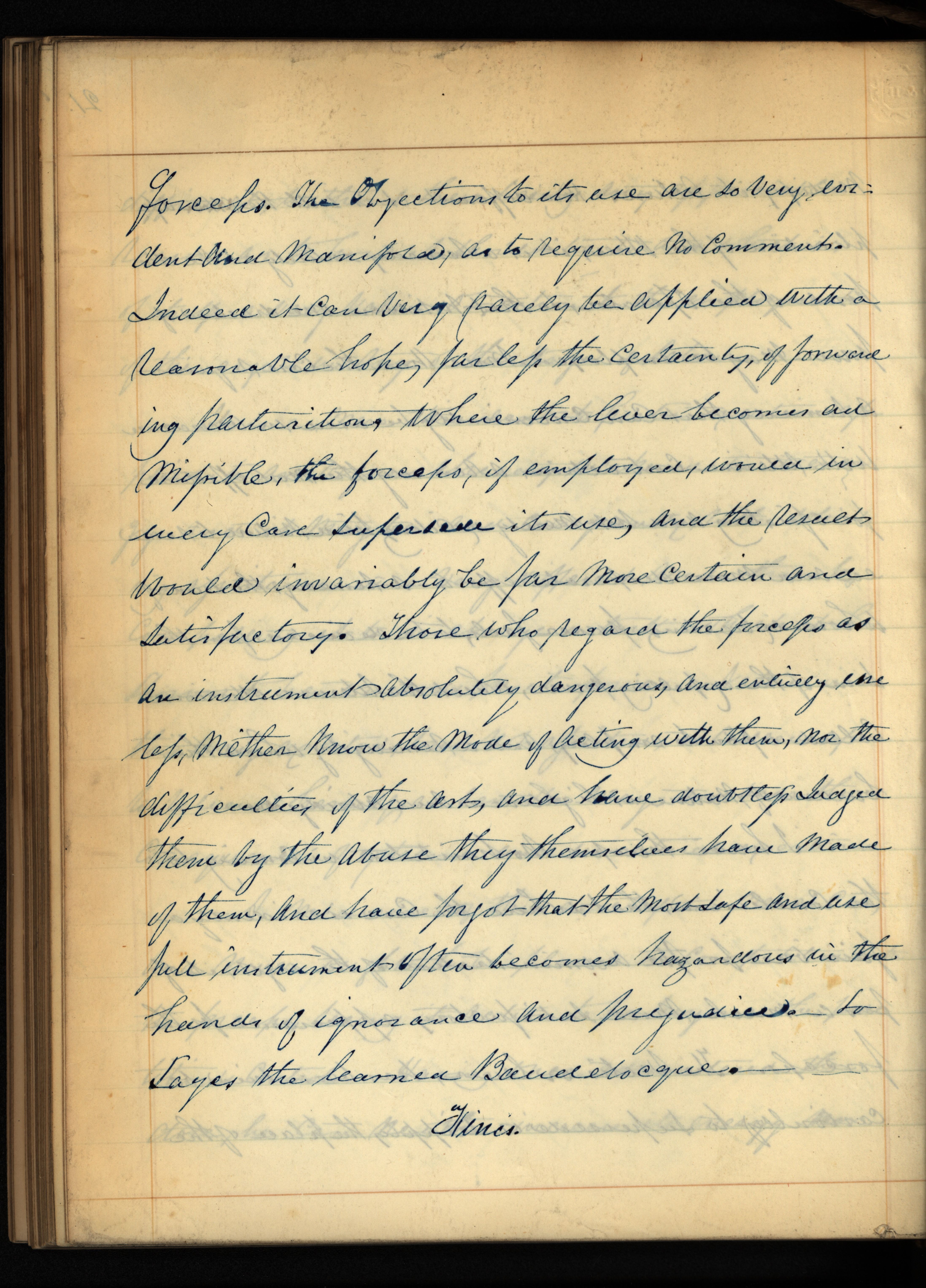
- OCR Text: ``` Forceps. The objections to its use are so very evident and manifold, as to require no comments.
- URL: `https://cdn.arke.institute/asset/MHFFGXMJ0D9PPLCTGAKI`
- Type: `image/tiff`
- Size: 80,465,084 bytes (≈80 MB)
- Filename: `test.tiff`
- Notes: This is a high‑resolution scan, suitable for detailed paleographic study. No OCR data is available.
- Rights: Not specified; the collection is currently marked as Unknown.
- Access URL: The placeholder indicates that a stable URL will be provided once the digital object is published.
- Institutional Repository: PINAX (Arke Institute)
---
3. Image JPEG (File 2)
Indeed it can very rarely be applied with a reasonable hope, far less the certainty, of forwarding parturition, where the lever becomes admissible, the forceps, if employed, would in every case supersede its use, and the result would invariably be far more certain and satisfactory. Those who regard the forceps as an instrument absolutely dangerous, and entirely ineffectual, neither know the mode of acting with them, nor the difficulties of the art, and have doubtless judged them by the abuse they themselves have made of them, and have forgot that the most safe and useful instrument often becomes hazardous in the hands of ignorance and prejudice—so says the learned B ```
---
4. Image TIFF (File 3)
---
5. Historical Context & Significance
The debate over forceps versus the lever reflects a pivotal moment in obstetric history. In the early 19th century, obstetricians were grappling with how best to assist difficult deliveries. The text demonstrates an early advocacy for forceps, arguing that proper technique can reduce maternal and fetal risk. Such documents help modern scholars trace the evolution of obstetric instruments and the professionalization of midwifery.
---
6. Access & Rights
---
7. Technical Details
| File | Format | Size | OCR | Notes | |------|--------|------|-----|-------| | File 1 | JSON | N/A | N/A | Metadata + full text | | File 2 | JPEG | 3.9 MB | Yes | Low‑resolution scan | | File 3 | TIFF | 80 MB | No | High‑resolution scan |
---
8. Conclusion
This archive offers a concise snapshot of 19th‑century obstetric discourse, combining textual analysis with visual reproductions. It serves as a valuable resource for historians of medicine, archivists, and scholars interested in the development of surgical instruments in childbirth.
---
```json { "collection": "test-archive", "description": "A small collection of a 19th‑century obstetric text and associated images.", "
Entities
(loading...)
Entity Relationships
(loading...)
Metadata
Files (2)
OCR Text
Forceps. The objections to its use are so very evident and manifold, as to require no comments. Indeed it can very rarely be applied with a reasonable hope, far less the certainty, of forwarding parturition, where the lever becomes admissible, the forceps, if employed, would in every case supersede its use, and the result would invariably be far more certain and satisfactory. Those who regard the forceps as an instrument absolutely dangerous, and entirely ineffectual, neither know the mode of acting with them, nor the difficulties of the art, and have doubtless judged them by the abuse they themselves have made of them, and have forgot that the most safe and useful instrument often becomes hazardous in the hands of ignorance and prejudice—so says the learned B
Version History (5 versions)
- ✓ v5 (current) · 10/31/2025, 10:31:57 PM
"Added description" - v4 · 10/31/2025, 10:31:44 PM · View this version
"Added PINAX metadata" - v3 · 10/31/2025, 10:31:36 PM · View this version
"Added OCR to test.jpg.ref.json" - v2 · 10/31/2025, 10:31:29 PM · View this version
"Set parent to 01K8Y6BB2ZC8WF2PRDBEHR2CXQ" - v1 · 10/31/2025, 10:31:28 PM · View this version
"Initial snapshot"
Parent
No children (leaf entity)