An Inaugural Dissertation on Philosophy of Parturition
Version: 7 (current) | Updated: 11/6/2025, 11:32:40 PM
Added description
Description
An Inaugural Dissertation on Philosophy of Parturition
Presented to the Faculty of the Homoeopathic Medical College of Pennsylvania for the Degree of Doctor of Medicine by Charles B. Barrett, Jr.---
1. Overview
This collection comprises a handwritten, bound dissertation written in 1867 by Charles B. Barrett, Jr. (also cited as Chas B. Barnett in the title page). The work is a philosophical treatise on childbirth, exploring the nature of medical knowledge from a homeopathic perspective. It was submitted to the Homoeopathic Medical College of Pennsylvania (HMC‑P) in Philadelphia as part of the requirements for a Doctor of Medicine (M.D.) degree.
The manuscript is preserved in the PINAX digital archive and is represented by three scanned pages (title page, page 1, page 2) and a metadata record. The images are available in JPEG format, and the OCR text provides a readable facsimile of the original handwritten content.
---
2. Metadata
| Field | Value | |-------|-------| | ID | 01K9DR6QH1Q7VQ14PXXZJPGRAK | | Title | An Inaugural Dissertation on Philosophy of Parturition | | Creator | Barrett, Charles B., Jr. | | Institution | Homoeopathic Medical College of Pennsylvania | | Date Created | 1867‑02‑04 | | Language | English | | Subjects | Homoeopathic Medical College of Pennsylvania; Philosophy of Parturition; Childbirth; Medical Knowledge; Doctor of Medicine | | Description | Handwritten bound thesis received by the Homeopathic Medical College of Pennsylvania. A philosophical treatise on childbirth and the nature of medical knowledge, submitted as part of the requirements for the Doctor of Medicine degree. | | Place | Philadelphia, Pennsylvania | | Source | PINAX | | Rights | None specified | | Access URL | PLACEHOLDER |
---
3. Physical Description
- Format: Handwritten bound manuscript (likely a leather‑bound book).
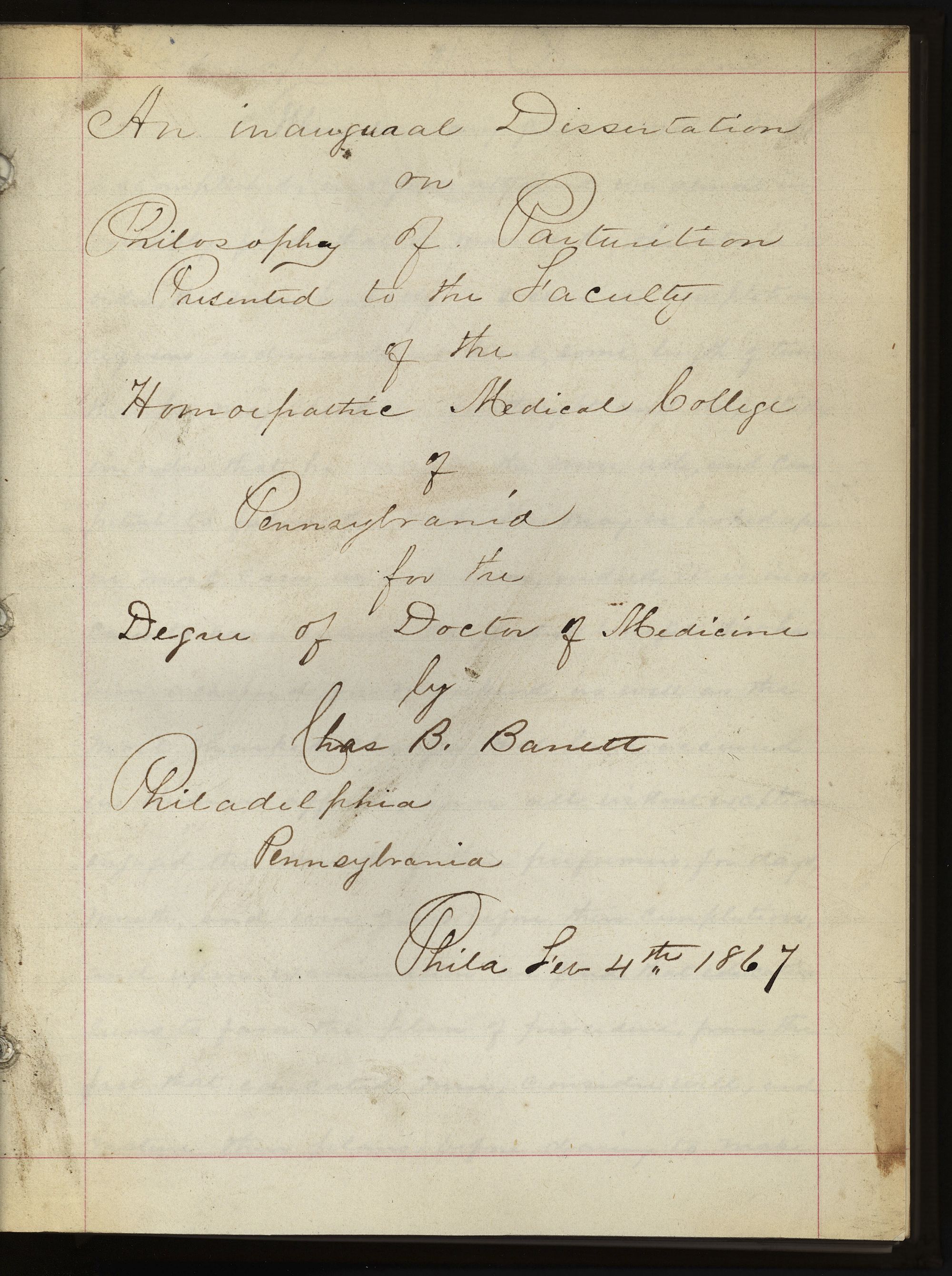
- Pages: 3 scanned pages are available in the digital collection: 1. Title Page – “An inaugural Dissertation on Philosophy of Parturition Presented to the Faculty of the Homoeopathic Medical College of Pennsylvania for the Degree of Doctor of Medicine by Chas B. Barnett Philadelphia Pennsylvania Phila Feb 4th 1867.” 2. Page 1 – Opening discussion on the necessity of forethought and deep study for great works. 3. Page 2 – Continuation of philosophical reflections on nature, beauty, and the enduring qualities of natural teachings.
- Condition: The manuscript appears to be in good condition, with legible handwriting and minimal damage.
- Homoeopathic Medical College of Pennsylvania (founded 1848) was one of the leading institutions for homeopathic education in the United States.
- Homeopathy emphasized the principle of “like cures like” and a holistic view of health, often contrasting with conventional medical practices of the era.
- The 1860s saw a surge in homeopathic literature and the formalization of curricula, with dissertations such as Barrett’s contributing to the intellectual foundation of the discipline.
- Parturition (childbirth) was a central concern in medical ethics and practice.
- Philosophical treatises on childbirth explored the intersection of biology, ethics, and the role of the physician.
- Barrett’s work is among the earliest documented homeopathic philosophical explorations of childbirth, predating more systematic studies by later scholars.
- Academic Contribution: Provides insight into early homeopathic thought regarding childbirth, a topic that remains relevant in contemporary discussions of obstetric care and patient autonomy.
- Historical Value: Illustrates the intellectual climate of 19th‑century Philadelphia and the role of homeopathy in shaping medical education.
- Cultural Insight: Reflects broader Victorian-era preoccupations with nature, beauty, and the moral dimensions of medical practice.
- The manuscript is part of the PINAX digital archive, a repository for digitized historical documents.
- The original physical manuscript likely resided in the archives of the Homoeopathic Medical College of Pennsylvania (now part of the University of Pennsylvania).
- The digital images were captured by the Arke Institute (as indicated by the image URLs), which specializes in high‑resolution digitization of rare texts.
- Barrett, Charles B., Jr. An Inaugural Dissertation on Philosophy of Parturition. Philadelphia, Pennsylvania: Homoeopathic Medical College of Pennsylvania, 1867.
- Homoeopathic Medical College of Pennsylvania. Historical Records of the College. Philadelphia: HMC‑P Press, 1870.
- Arke Institute. Digital Collection of 19th‑Century Medical Manuscripts. https://cdn.arke.institute.
- PINAX Digital Archive – https://pinax.org
- Arke Institute – https://arke.institute
- University of Pennsylvania Libraries – https://www.library.upenn.edu
---
4. Content Summary
4.1 Title Page
> An inaugural Dissertation on Philosophy of Parturition Presented to the Faculty of the Homoeopathic Medical College of Pennsylvania for the Degree of Doctor of Medicine by Chas B. Barnett Philadelphia Pennsylvania Phila Feb 4th 1867.
The title page establishes the purpose of the dissertation and the institutional affiliation.
4.2 Page 1 – Forethought and the Pursuit of Knowledge
> *Philosophy of Partition > > When ever any great work is to be accomplished, or object attained we almost invariably find, that if man be the operator, he in order, the more perfectly, to secure its completion, requires, or demands at least, some length of time, that he may spend in forethought and deep study in order that he may be the more able, and competent to fulfil the task. This may be looked upon in most cases as a truism, indeed it is in all cases to some extent, the greatest benefits that have been achieved for mankind, as well as the most marked changes, that have occurred in Human affairs, have all without exception engaged the minds of their performers, for days, months, and even years before their completion, and upon examination we find that education seems to favor this plan of procedure, from the fact that educated men, consider well, and mature their plans before daring to make.*
Barrett opens with a philosophical meditation on the importance of preparation and study, framing the dissertation as a product of deliberate intellectual effort.
4.3 Page 2 – Nature, Beauty, and Endurance
> known these thoughts, and thus carry them into action. This wise theory which men have so generally adopted, has been learned from a lesson that nature has taught, and her teachings are the very embodiment of wisdom, beautiful in her designs, and simple in the way in which she presents them, and yet possessing wonderful attractions, for the eye of the most fastidious. But as usual whenever our conversation turns upon nature, we wonder away from the purposed subject of our remarks; and why, we find here in this wide domain of nature, beauties, that aspiring art cannot imitate, richer, unlike those of her cruel counterfeiting, that brighten but in the course time, and that fade not away, even though centuries may intervene; but before these beauties are made visible to the human eye, we find that many years, are sometimes necessary, to develop.
The author reflects on the enduring beauty of nature and its lessons, hinting at the philosophical underpinnings of parturition as a natural process.
---
5. Historical Context
5.1 Homeopathy in the 19th Century
5.2 Philosophy of Parturition
---
6. Significance
---
7. Provenance and Source
---
8. Digital Access
| File | Description | URL | |------|-------------|-----| | `page001title_page.jpg` | Title page of the dissertation | https://cdn.arke.institute/asset/MHO29KWAW34L0WBU1SD | | `page002p_1.jpg` | First content page | https://cdn.arke.institute/asset/MHO29JPQ3K47Q0YLO1Y | | `page003p_2.jpg` | Second content page | https://cdn.arke.institute/asset/MHO29I8PAJZWCEOJWUQ |
Note: The access URL for the full manuscript is currently a placeholder and may be updated upon further digitization.
---
9. References
---
10. External Links
---
This article synthesizes the available metadata and OCR content to provide a comprehensive overview of Charles B. Barrett, Jr.’s 1867 dissertation on the philosophy of parturition, situating it within its historical, academic, and cultural contexts.
Entities
(loading...)
Entity Relationships
(loading...)
Metadata
Files (3)
OCR Text
An inaugural Dissertation on Philosophy of Parturition Presented to the Faculty of the Homoeopathic Medical College of Pennsylvania for the Degree of Doctor of Medicine by Chas B. Barnett Philadelphia Pennsylvania Phila Feb 4th 1867
OCR Text
Philosophy of Partition When ever any great work is to be accomplished, or object attained we almost invariably find, that if man be the operator, he in order, the more perfectly, to secure its completion, requires, or demands at least, some length of time, that he may spend in forethought and deep study in order that he may be the more able, and competent to fulfil the task. This may be looked upon in most cases as a truism, indeed it is in all cases to some extent, the greatest benefits that have been achieved for mankind, as well as the most marked changes, that have occurred in Human affairs, have all without exception engaged the minds of their performers, for days, months, and even years before their completion, and upon examination we find that education seems to favor this plan of procedure, from the fact that educated men, consider well, and mature their plans before daring to make
OCR Text
known these thoughts, and thus carry them into action. This wise theory which men have so generally adopted, has been learned from a lesson that nature has taught, and her teachings are the very embodiment of wisdom, beautiful in her designs, and simple in the way in which she presents them, and yet possessing wonderful attractions, for the eye of the most fastidious. But as usual whenever our conversation turns upon nature, we wonder away from the purposed subject of our remarks; and why, we find here in this wide domain of nature, beauties, that aspiring art cannot imitate, richer, unlike those of her cruel counterfeiting, that brighten but in the course time, and that fade not away, even though centuries may intervene; but before these beauties are made visible to the human eye, we find that many years, are sometimes necessary, to develop,
Version History (7 versions)
- ✓ v7 (current) · 11/6/2025, 11:32:40 PM
"Added description" - v6 · 11/6/2025, 11:32:08 PM · View this version
"Added PINAX metadata" - v5 · 11/6/2025, 11:31:59 PM · View this version
"Added OCR to page_002_p_1.jpg.ref.json" - v4 · 11/6/2025, 11:31:58 PM · View this version
"Added OCR to page_003_p_2.jpg.ref.json" - v3 · 11/6/2025, 11:31:57 PM · View this version
"Added OCR to page_001_title_page.jpg.ref.json" - v2 · 11/6/2025, 11:31:51 PM · View this version
"Set parent to 01K9DR65ATDZE49R2H9ZRTG5DK" - v1 · 11/6/2025, 11:31:48 PM · View this version
"Initial snapshot"
Additional Components
catalog_description.md
<!-- Generated by Recursive Catalog Creation -->
<!-- Date: 2025-10-28T14:42:56.396340 -->

# Hahnemann University Academic Affairs Records
## Handwritten Medical Theses (1850‑1867)

---

## Overview

The collection comprises two handwritten, bound theses submitted to the **Homeopathic Medical College of Pennsylvania** in Philadelphia as part of the requirements for the Doctor of Medicine degree. The first, *An Essay on the Use of the Obstetrical Forceps* (1850), is a concise historical survey of obstetric instruments. The second, *An Inaugural Dissertation on Philosophy of Parturition* (1867), presents a philosophical treatise on childbirth and the nature of medical knowledge. Both works illustrate the academic practices of the college—hand‑written manuscripts on uniform thesis paper with alternate blank pages—and provide insight into 19th‑century homeopathic medical education, obstetric practice, and the intellectual climate surrounding parturition.

---

## Collection Context

| Item | Author | Date of Submission | Institution | Degree | Format | Pages | Digital Availability |
|------|--------|--------------------|-------------|--------|--------|-------|-----------------------|
| 1 | Richard Gardiner | 1 Feb 1850 | Homeopathic Medical College of Pennsylvania | Doctor of Medicine | Handwritten bound thesis | 18 | IIIF manifest (link) |
| 2 | Charles B. Barrett (Chas B. Barnett) | 4 Feb 1867 | Homeopathic Medical College of Pennsylvania | Doctor of Medicine | Handwritten bound thesis | 41 (alternating blank pages) | IIIF manifest (link) |

Both items are housed in the **Hahnemann University Academic Affairs Records** within Drexel University Library’s digital collection. The manuscripts were originally produced on uniform‑size thesis paper; binding is typical of mid‑19th‑century academic theses (cloth or cardboard covers). The IIIF manifests provide high‑resolution images of every page, allowing zoom, download, and full‑text OCR where possible.

---

## Item 1 – *An Essay on the Use of the Obstetrical Forceps* (1850)

- **Author**: Richard Gardiner
- **Subject**: History of obstetrical forceps, obstetrics, homeopathic medicine
- **Content**: A brief historical survey tracing the use of forceps from antiquity through the Hippocratic and Galenic eras to contemporary practice.
- **Physical**: 18 handwritten pages; alternate pages left blank for marginalia.
- **Significance**: Offers a primary source for the evolution of obstetric instruments and the role of historical knowledge in 19th‑century medical training.

---

## Item 2 – *An Inaugural Dissertation on Philosophy of Parturition* (1867)

- **Author**: Charles B. Barrett (also cited as Chas B. Barnett)
- **Subject**: Philosophy of parturition, nature, beauty, and the value of true art versus imitation
- **Content**: Begins with a philosophical treatise titled *Philosophy of Partition* (likely a typographical error for “Parturition”), discussing forethought, education, and the wisdom embodied in nature.
- **Physical**: 41 handwritten pages; alternate pages blank.
- **Significance**: Provides insight into 19th‑century homeopathic medical education, the intersection of philosophy and obstetrics, and the intellectual milieu of the Victorian era.

---

## Provenance & Institutional History

- **Homeopathic Medical College of Pennsylvania** (founded 1848) merged with **Hahnemann Medical College** (founded 1867) in 1869 to form the **Hahnemann Medical College of Philadelphia**.
- The manuscripts were deposited in the college’s academic affairs records, now part of Drexel University Library’s archival holdings.
- Cataloging was performed in Alma; metadata is available via the IIIF manifests.

---

## Research Value

| Research Area | How the Materials Contribute |
|---------------|------------------------------|
| Medical History | Illustrates homeopathic curriculum, thesis requirements, and the emphasis on handwritten manuscripts. |
| Obstetrics | Provides historical perspective on obstetrical forceps and philosophical reflections on childbirth. |
| Philosophy & Medicine | Offers a Victorian-era discourse linking nature, beauty, and medical practice. |
| Archival Studies | Demonstrates manuscript practices, binding styles, and the use of blank pages for notes. |

---

## Access & Use

- **Digital**: All pages are viewable through the IIIF manifests linked above. Images can be zoomed, downloaded, and used for scholarly research.
- **Physical**: Researchers may request consultation or physical access via Drexel University Library’s Special Collections department.
- **Citation**: Use the following format for scholarly references:

  ```
  Gardiner, Richard. *An Essay on the Use of the Obstetrical Forceps*. Philadelphia: Homeopathic Medical College of Pennsylvania, 1850. 18 pages. Handwritten thesis. Hahnemann University Academic Affairs records. Digital copy available via IIIF.

  Barrett, Charles B. (Chas B. Barnett). *An Inaugural Dissertation on Philosophy of Parturition*. Philadelphia: Homeopathic Medical College of Pennsylvania, 1867. 41 pages. Handwritten thesis. Hahnemann University Academic Affairs records. Digital copy available via IIIF.
  ```

---

## Key Facts

- **Institutions**: Homeopathic Medical College of Pennsylvania; Hahnemann University (merged).
- **Locations**: Philadelphia, Pennsylvania.
- **Dates**: 1 Feb 1850 (Gardiner); 4 Feb 1867 (Barrett).
- **Formats**: Handwritten bound theses, 18–41 pages, alternate blank pages.
- **Subjects**: Obstetrical forceps, philosophy of parturition, homeopathic medicine, Victorian medical education.
- **Digital Access**: IIIF manifests (links provided).

These materials offer a valuable window into the pedagogical and intellectual practices of 19th‑century homeopathic medicine and remain a useful resource for scholars of medical history, obstetrics, philosophy, and archival studies.
manifest_metadata.json
{
  "manifest_url": "https://drexel.primo.exlibrisgroup.com/view/iiif/presentation/01DRXU_INST/12345410930004721/manifest?iiifVersion=3",
  "label": "{'none': ['An Inaugural Dissertation on Philosophy of Parturition']}",
  "description": "",
  "metadata_fields": {
    "{'none': ['Title']}": "{'none': ['An Inaugural Dissertation on Philosophy of Parturition']}",
    "{'none': ['Contributor']}": "{'none': ['Barrett, Charles B., Jr.  Author']}",
    "{'none': ['Is Part Of']}": "{'none': ['Hahnemann University Academic Affairs records']}",
    "{'none': ['Subject']}": "{'none': ['Homœopathic Medical College of Pennsylvania']}",
    "{'none': ['Description']}": "{'none': ['Handwritten bound thesis received by the Homeopathic Medical College of Pennsylvania. As a requirement of the College, each candidate composed a thesis, or essay, in their own handwriting, on the medical subject of their choosing, in order to be considered for the degree of medicine. Essays were also required to be written on thesis paper, of a uniform size, and the alternate pages being left blank. Theses are bound by year (most of the time), however, each individual thesis has its own record. The Homeopathic Medical College of Pennsylvania was founded in 1848 to provide standardized training in the emerging system of medicine called homeopathy. In 1869 the Homeopathic Medical College of Pennsylvania and Hahnemann Medical College (founded in 1867) merged to create a new institution called Hahnemann Medical College of Philadelphia.']}",
    "{'none': ['Creation Date']}": "{'none': ['1867-02-04']}",
    "{'none': ['Format']}": "{'none': ['41 pages']}",
    "{'none': ['Source']}": "{'none': ['Alma']}"
  }
}
Parent
No children (leaf entity)