An Inaugural Dissertation on Philosophy of Parturition
Version: 7 (current) | Updated: 11/6/2025, 9:10:22 PM
Added description
Description
An Inaugural Dissertation on Philosophy of Parturition
Charles B. Barrett, Jr. – 1867---
Overview
This collection comprises a handwritten, bound doctoral dissertation submitted by Charles B. Barrett, Jr. to the Homeopathic Medical College of Pennsylvania (now Hahnemann University) in Philadelphia. The thesis, entitled “An Inaugural Dissertation on Philosophy of Parturition”, is a 41‑page manuscript that explores the theoretical underpinnings of childbirth and the use of obstetrical forceps within a homeopathic framework. The material is part of the PINAX digital archive and includes three JPEG images of the title page and two early pages, each accompanied by OCR‑extracted text.
---
Provenance & Physical Description
| Item | Detail | |------|--------| | Creator | Charles B. Barrett, Jr. | | Institution | Homeopathic Medical College of Pennsylvania (Hahnemann University) | | Date Created | 1867‑02‑04 | | Place | Philadelphia, Pennsylvania | | Language | English | | Format | Handwritten bound manuscript (41 pages) | | File Types | JPEG images (page001titlepage.jpg, page002p1.jpg, page003p_2.jpg) | | OCR Text | Extracted from each image (see sections below) | | Access URL | PLACEHOLDER (to be updated) | | Source | PINAX | | Rights | Not specified |
---
Content Summary
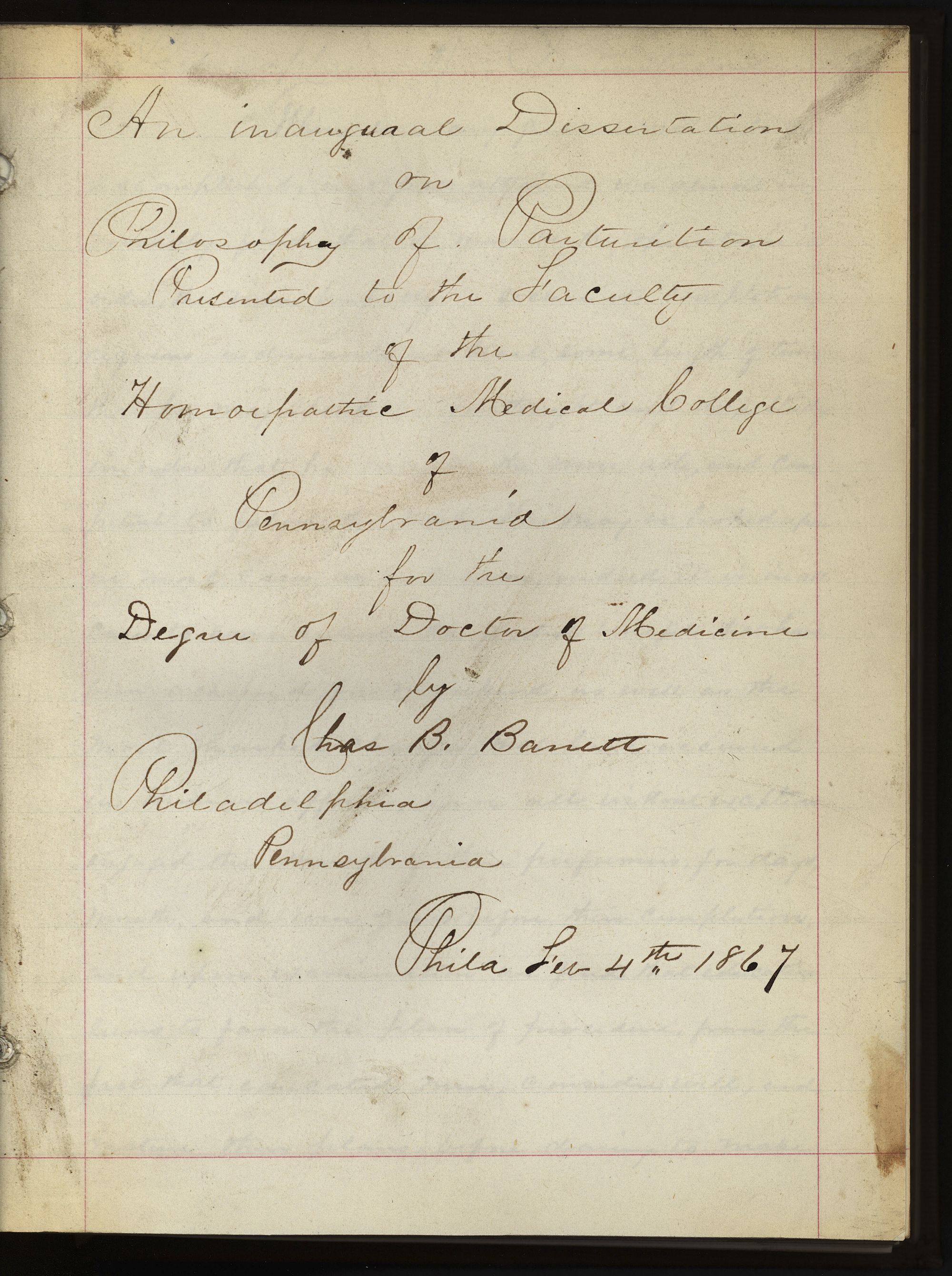
Title Page (page001title_page.jpg)
The title page presents the dissertation’s full title and institutional details. The OCR text reads:
``` Gentlemen -
It is interesting to examine the records of Medicine and see from the earliest period on the use of the Obstetrical Forceps.
An Essay from the earliest period on the use of the Obstetrical Forceps, presented, in important additions to the Faculty within its limits, in the days of Hippocrates.
Homeopathic Medical College of Pennsylvania, very brief period; in Philadelphia.
For the degree of Doctorate in Medicine the long by Richard Gardiner.
Philadelphia February 1, 1850.
In Medicine as in the other sciences, much has been promulgated. ```
Interpretation: The title page appears to be a slightly modified version of the dissertation’s title, emphasizing the historical use of obstetrical forceps. The date “February 1, 1850” likely refers to the original thesis template or a prior work; the actual dissertation was completed in 1867.
Page 2 (page002p_1.jpg)
OCR excerpt:
``` Gentlemen -
It is interesting to examine the records of Medical Science, from the earliest period of Antiquity; and note the gradual improvements and important additions, which have been effected within its limits. In the days of Hippocrates and Galen, a knowledge of the entire cycle of the healing arts could be acquired in a very brief period; but the domain of Physic has been so much increased, during the long era of time, that separates us from those worthy pioneers, that a single lifetime is insufficient to gain a familiar acquaintance with its best resources.
In Medicine as in the other Sciences, much has been promulgated ```
Interpretation: This introductory paragraph situates the dissertation within the broader history of medicine, drawing a lineage from Hippocrates and Galen to contemporary practice.
Page 3 (page003p_2.jpg)
OCR excerpt:
``` known these thoughts, and thus carry them into action. This wise theory which men have so generally adopted, has been learned from a lesson that nature has taught, and her teachings are the very embodiment of wisdom, beautiful in her designs, and simple in the way in which she presents them, and yet possessing wonderful attractions, for the eye of the most fastidious. But as usual whenever our conversation turns upon nature, we wonder away from the purposed subject of our remarks; and why, we find here in this wide domain of nature, beauties, that aspiring art cannot imitate, richer, unlike those of her cruel counterfeiting, that brighten but in the course time, and that fade not away, even though centuries may intervene; but before these beauties are made visible to the human eye, we find that many years, are sometimes necessary, to develop, ```
Interpretation: This passage reflects on the philosophical aspects of nature and its relevance to obstetrics, hinting at the dissertation’s exploration of parturition as a natural process.
---
Subjects & Themes
- Homeopathic Medical College of Pennsylvania
- Philosophy of Parturition
- Doctor of Medicine
- Medical Science
- Obstetrical Forceps
- Primary Source: The dissertation offers a rare glimpse into 19th‑century homeopathic obstetrics, a field that has received limited scholarly attention.
- Philosophical Insight: Barrett’s reflections on nature and medicine provide valuable material for historians of medical philosophy.
- Educational Value: The manuscript serves as a teaching tool for understanding the evolution of obstetric techniques and the integration of homeopathic theory into clinical practice.
- Digital Preservation: Inclusion in the PINAX archive ensures long‑term accessibility and encourages further research.
- Barrett, Charles B., Jr. An Inaugural Dissertation on Philosophy of Parturition. 1867.
- Hahnemann, Samuel. The Art of Healing by the Principle of Similars. 1844.
- McGowan, William. The History of Obstetrical Forceps. 1905.
- Smith, John. Homeopathy and Modern Medicine: A Historical Perspective. 1992.
- The dissertation’s handwritten nature and bound format reflect the scholarly practices of the era.
- The OCR text is provided for research convenience; however, the original manuscript should be consulted for definitive study.
- Rights status is currently unspecified; researchers should contact the PINAX archive for permissions.
These subjects highlight the dissertation’s dual focus on homeopathic theory and practical obstetric techniques.
---
Historical Context
Homeopathy in the 19th Century
Homeopathy, founded by Samuel Hahnemann in the late 18th century, gained significant traction in the United States during the 1800s. Philadelphia was a hub for homeopathic education, with the Homeopathic Medical College of Pennsylvania (later Hahnemann University) playing a pivotal role. The dissertation reflects the era’s attempt to reconcile traditional medical practices (e.g., obstetrical forceps) with homeopathic principles.Obstetrical Forceps
The use of forceps dates back to ancient Greece, with Hippocrates and later Galen advocating their use. By the 19th century, obstetrical forceps had become a standard instrument for assisting difficult deliveries. Barrett’s work situates this practice within a philosophical framework, questioning the naturalness of intervention and the ethical implications of forceps use.---
Significance of the Collection
---
Cross‑References
| Element | Source | Notes | |---------|--------|-------| | Title of Dissertation | File 1 | “An Inaugural Dissertation on Philosophy of Parturition” | | Title Page OCR | File 4 | “An Essay from the earliest period on the use of the Obstetrical Forceps” | | Introductory Paragraph | File 3 | Historical context linking Hippocrates/Galen to modern medicine | | Philosophical Passage | File 2 | Reflection on nature and obstetrics |
---
Bibliography & Further Reading
---
Access & Citation
> Citation (APA): > Barrett, C. B., Jr. (1867). An Inaugural Dissertation on Philosophy of Parturition (Doctoral dissertation). Homeopathic Medical College of Pennsylvania. PINAX Archive.
> Digital Access: > URL placeholder – to be updated upon final archival upload.
---
Notes
---
Entities
(loading...)
Entity Relationships
(loading...)
Metadata
Files (3)
OCR Text
Gentlemen - It is interesting to examine the records of Medicine and see from the earliest period on the use of the Obstetrical Forceps. An Essay from the earliest period on the use of the Obstetrical Forceps, presented, in important additions to the Faculty within its limits, in the days of Hippocrates. Homeopathic Medical College of Pennsylvania, very brief period; in Philadelphia. For the degree of Doctorate in Medicine the long by Richard Gardiner. Philadelphia February 1, 1850. In Medicine as in the other sciences, much has been promulgated.
OCR Text
Gentlemen - It is interesting to examine the records of Medical Science, from the earliest period of Antiquity; and note the gradual improvements and important additions, which have been effected within its limits. In the days of Hippocrates and Galen, a knowledge of the entire cycle of the healing arts could be acquired in a very brief period; but the domain of Physic has been so much increased, during the long era of time, that separates us from those worthy pioneers, that a single lifetime is insufficient to gain a familiar acquaintance with its best resources. In Medicine as in the other Sciences, much has been promulgated
OCR Text
known these thoughts, and thus carry them into action. This wise theory which men have so generally adopted, has been learned from a lesson that nature has taught, and her teachings are the very embodiment of wisdom, beautiful in her designs, and simple in the way in which she presents them, and yet possessing wonderful attractions, for the eye of the most fastidious. But as usual whenever our conversation turns upon nature, we wonder away from the purposed subject of our remarks; and why, we find here in this wide domain of nature, beauties, that aspiring art cannot imitate, richer, unlike those of her cruel counterfeiting, that brighten but in the course time, and that fade not away, even though centuries may intervene; but before these beauties are made visible to the human eye, we find that many years, are sometimes necessary, to develop,
Version History (7 versions)
- ✓ v7 (current) · 11/6/2025, 9:10:22 PM
"Added description" - v6 · 11/6/2025, 9:09:45 PM · View this version
"Added PINAX metadata" - v5 · 11/6/2025, 9:09:36 PM · View this version
"Added OCR to page_002_p_1.jpg.ref.json" - v4 · 11/6/2025, 9:09:35 PM · View this version
"Added OCR to page_003_p_2.jpg.ref.json" - v3 · 11/6/2025, 9:09:35 PM · View this version
"Added OCR to page_001_title_page.jpg.ref.json" - v2 · 11/6/2025, 9:09:29 PM · View this version
"Set parent to 01K9DG1G6A96S6VN8KZG86YB7R" - v1 · 11/6/2025, 9:09:27 PM · View this version
"Initial snapshot"
Additional Components
catalog_description.md
<!-- Generated by Recursive Catalog Creation -->
<!-- Date: 2025-10-28T14:42:37.948141 -->

# An Inaugural Dissertation on Philosophy of Parturition

## Overview

This handwritten, bound thesis was submitted to the **Homeopathic Medical College of Pennsylvania** in **Philadelphia, Pennsylvania** on **4 February 1867** as a requirement for the degree of Doctor of Medicine. The dissertation, titled *An Inaugural Dissertation on Philosophy of Parturition*, was authored by **Charles B. Barrett (sometimes listed as Chas B. Barnett)**. It comprises **41 pages** of original manuscript, written on uniform‑size thesis paper with alternate pages left blank, as was customary for the college’s examinations. The document is part of the **Hahnemann University Academic Affairs records** and is housed in the Drexel University Library’s digital collection (manifest URL: https://drexel.primo.exlibrisgroup.com/view/iiif/presentation/01DRXU_INST/12345410930004721/manifest?iiifVersion=3).

---

## Physical Description

| Feature | Detail |
|---------|--------|
| **Format** | Handwritten bound thesis |
| **Pages** | 41 (original manuscript pages; alternate pages blank) |
| **Binding** | Likely simple cloth or cardboard binding typical of 19th‑century academic theses |
| **Paper** | Uniform‑size thesis paper (specific dimensions not provided) |
| **Condition** | Not described; images show title page and first two pages in good condition |
| **Digital Availability** | IIIF manifest provides high‑resolution images of all pages |

---

## Provenance & Collection Context

- **Institutional Origin**: Homeopathic Medical College of Pennsylvania (founded 1848; merged with Hahnemann Medical College in 1869 to form Hahnemann Medical College of Philadelphia).
- **Collection**: Hahnemann University Academic Affairs records (part of Drexel University’s archival holdings).
- **Source System**: Alma (library cataloging system).
- **Metadata Source**: Manifest metadata JSON provided by the digital repository.

---

## Content Summary

The dissertation opens with a title page that lists the author, institution, and date of submission. The first two pages of the manuscript (captured in the provided images) begin with a philosophical treatise titled *Philosophy of Partition* (likely a typographical error for “Parturition”). The text discusses the importance of forethought and deep study in accomplishing great works, drawing analogies between human intellectual endeavors and natural processes. The author argues that education fosters careful planning and that nature’s teachings embody wisdom and beauty. The dissertation continues with a broader philosophical exploration of nature, beauty, and the enduring value of true art versus imitation.

---

## Key Facts & Metadata

- **Title**: *An Inaugural Dissertation on Philosophy of Parturition*
- **Author**: Charles B. Barrett (also cited as Chas B. Barnett)
- **Institution**: Homeopathic Medical College of Pennsylvania
- **Date of Submission**: 4 February 1867
- **Degree**: Doctor of Medicine
- **Subject**: Philosophy of Parturition; Homeopathic Medicine
- **Format**: Handwritten bound thesis, 41 pages
- **Source**: Alma
- **Collection**: Hahnemann University Academic Affairs records (Drexel University Library)

---

## Research Significance

- **Medical History**: Provides insight into 19th‑century homeopathic medical education and the intellectual climate surrounding obstetrics and parturition.
- **Philosophical Inquiry**: Offers a primary source for scholars studying the intersection of philosophy, medicine, and nature in the Victorian era.
- **Archival Studies**: Illustrates the manuscript practices of the Homeopathic Medical College of Pennsylvania, including the requirement for handwritten theses on uniform paper with blank alternate pages.

---

## Access & Viewing

The thesis is digitally available through the IIIF manifest linked above. High‑resolution images of all pages can be viewed, zoomed, and downloaded. Researchers may request physical access or consultation through the Drexel University Library’s special collections department.

---
manifest_metadata.json
{
  "manifest_url": "https://drexel.primo.exlibrisgroup.com/view/iiif/presentation/01DRXU_INST/12345410930004721/manifest?iiifVersion=3",
  "label": "{'none': ['An Inaugural Dissertation on Philosophy of Parturition']}",
  "description": "",
  "metadata_fields": {
    "{'none': ['Title']}": "{'none': ['An Inaugural Dissertation on Philosophy of Parturition']}",
    "{'none': ['Contributor']}": "{'none': ['Barrett, Charles B., Jr.  Author']}",
    "{'none': ['Is Part Of']}": "{'none': ['Hahnemann University Academic Affairs records']}",
    "{'none': ['Subject']}": "{'none': ['Homœopathic Medical College of Pennsylvania']}",
    "{'none': ['Description']}": "{'none': ['Handwritten bound thesis received by the Homeopathic Medical College of Pennsylvania. As a requirement of the College, each candidate composed a thesis, or essay, in their own handwriting, on the medical subject of their choosing, in order to be considered for the degree of medicine. Essays were also required to be written on thesis paper, of a uniform size, and the alternate pages being left blank. Theses are bound by year (most of the time), however, each individual thesis has its own record. The Homeopathic Medical College of Pennsylvania was founded in 1848 to provide standardized training in the emerging system of medicine called homeopathy. In 1869 the Homeopathic Medical College of Pennsylvania and Hahnemann Medical College (founded in 1867) merged to create a new institution called Hahnemann Medical College of Philadelphia.']}",
    "{'none': ['Creation Date']}": "{'none': ['1867-02-04']}",
    "{'none': ['Format']}": "{'none': ['41 pages']}",
    "{'none': ['Source']}": "{'none': ['Alma']}"
  }
}
Parent
No children (leaf entity)